"To be nobody but yourself in a world that's doing its best to make you somebody else, is to fight the hardest battle you are ever going to fight. Never stop fighting." E. E. Cummings
The magic eye moment. Remember magic eyes? When you stare at a blurry image and suddenly a three dimensional shape pops out. And bam, you get it. There’s a place in Meta’s Metaverse where you can see the magic eye moment in action.
When newbies sign in — after learning how to walk, after picking their avatar — and they enter into conversation with one another for the first time. It’s not that moment but a split second later, when two avatars touch hands and your controller vibrates, that’s the magic eye moment. Realizing that a virtual gesture is physically resonating with someone across worlds from you.
I’m sure you’ve read endlessly about metaverse, but you should really try it out yourself before forming an opinion. Today, while exploring, I watched a standup comedy routine, met several people from multiple countries, and explored a digital art gallery.
I’ve always loved meeting new people and bringing great people together and am excited for more friends to adopt the technology so we can experience it at the same time.
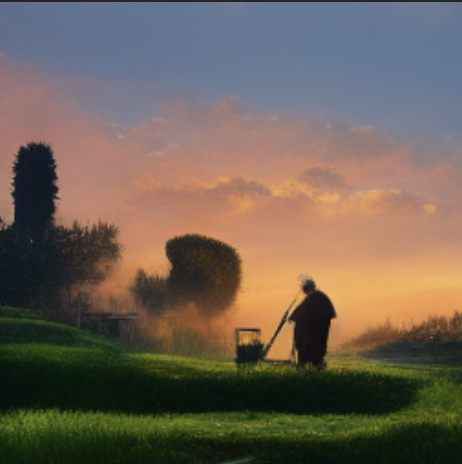
There’s a small Italian man in his 80s with a beautiful smile. He cares for his lawn and the lawns of his neighbors. He is in no hurry. He takes pride in the doing: the chopping, the cutting, the planting, and the pruning. I’ve never seen him touch a mobile phone. He’s never seen me without one. One day, I asked his help to remove a tree. But first he watched me attempt it on my own: trying to rock it, uproot it, even will it to fall over. After several unsuccessful tries, I abandoned the task to eat lunch. When I returned, he had removed the tree. He looked at me kindly and said nothing.
Creating a small space, a tiny habit, is the basis for creating a big space, and a repeatable habit. This sounds so obvious, but the advice has been transformative for me. Starting with simply showing up to a task, a prayer, writing, breathing, whatever it is you want to focus on, showing up with intention every day builds the foundation for self-trust and for deeper and more meaningful work. This turns choirs into rituals, and rituals into practice: something solid and true.
The real meditation is how you live your life.” – Jon Kabat-Zinn
It never rains here. At any moment it looks like will start. The city awakens when the neons lights are seen. The faceless women walks by me again. I am awake. I’ve pinched myself twice, thrice. I am fully alert: jazz in my head, in my heart & hands, moving my feet with a beat. Song everywhere now: horns, steam, pigeon’s feet slap the sidewalk like angry spatulas. The faceless woman winks at me. She’s better dressed than me. Motels taunt lovers with no vacancy signs. The subway will never take you this far.
There’s a technique that one of my closest friends, who is a priest, uses to experience his beliefs. He takes a scene that is meaningful to him, a scene from a holy book, an imagines himself in that scene with exquisite detail. Applying each one of his senses, he lingers in that scene, living the words.
I’ve heard of a similar technique being used in therapy. This practice of inserting oneself entirely into a scene is something I am curious about. Without even meaning to, I realize that the scene I would inhabit comes from the Count of Monte Cristo, shortly after Edmond Dantes emerges from prison, filled with rage, hope, joy, and encouraged by the relentless weather.
How raw and human the experience, and how much I can learn from exploring it fully, slowly, as if I were actually there.
Hunting around online, I discovered the name for this practice, “Ignatian contemplation.”
You can’t depend on your eyes when your imagination is out of focus – Mark Twain
If you work in business, you must have heard about the importance of storytelling a million times by now. As if that proclamation alone is a divine insight. But what we don’t hear enough about is imagination.
Sure, we know about brainstorming, and the more progressive among us celebrate question-storming, but what of that quiet yet burning curiosity to imagine the unknown–to fill the blank screen with possibilities, or even direct AI to create.
How are you practicing strengthening your imagination?
We have a favorite four year old. She’s our neighbor, and she’s extraordinarily smart. If you say a word in passing, like “splendid” she’ll remember it and use it in context. Today we greeted her and her mother.
We played a round of imaginary games including birthday party.
When we went to blow out the candles, it confused her. Having most of her memories from during the pandemic, she’s never seen candles being blown out on a cake before. I wonder what other childhood experiences will be vastly different for those who started remembering in 2020.
I’m conducting a fireside chat with an influential entrepreneur next week. I’ve reviewed his Ted Talk. I’ve read his Harvard Business Review case study. I’ve seen his incredible accomplishments, and we spoke for about an hour on the phone to plan. I’ve put together rounds of questions and edited them not just to get the content right, but also to ensure the flow is clear and creates good energy.
Interviewers make the mistake of thinking that they have to sound smart, when, in fact, that’s not the point at all. The point is help the interviewee tell memorable, compelling stories that resonate with the audience, and to create a balance of what the audience wants to know and what the interviewee wants to share. You don’t necessarily do this by asking hard, complex questions; a sincere question which generously sets up the interviewee for a great story is even more effective.









 A Life of Wonder