Feeds:
Posts
Comments

Rituals protect us. We step in & out of them to receive information and open a part of ourselves otherwise inaccessible. They connect us to something greater. They allow us to relax our conscious mind and rest into practices which hold us. We often forget that we can design our own rituals. Unlike ceremonies, which are performed for occasions, we evoke rituals for their symbolic power. 

What rituals do you practice which are not also ceremonies?

Elevate the mundane with ritual by bringing intention and symbolism to it. Even the act of boiling water can create ritual and move from a task to a sacred gesture. 

“A ritual is the enactment of a myth. And, by participating in the ritual, you are participating in the myth. And since myth is a projection of the depth wisdom of the psyche, by participating in a ritual, participating in the myth, you are being, as it were, put in accord with that wisdom, which is the wisdom that is inherent within you anyhow. Your consciousness is being re-minded of the wisdom of your own life. I think ritual is terribly important.”

― Joseph Campbell

The Wise Ones

“Feelings come and go like clouds in a windy sky. Conscious breathing is my anchor.”― Thich Nhat Hang, Stepping into Freedom: Rules of Monastic Practice for Novices

So many of the wise ones advise us to notice how our thoughts move in and out of our mind and that the act of noticing creates a space between ourselves, as a witness observer, and our thoughts, as the thing which is being observed. These wise ones grasp serenity, stillness and depth through practice and non-judgement.

If you just sit and observe, you will see how restless your mind is. If you try to calm it, it only makes it worse, but over time it does calm, and when it does, there’s room to hear more subtle things – that’s when your intuition starts to blossom and you start to see things more clearly and be in the present more. Your mind just slows down, and you see a tremendous expanse in the moment. You see so much more than you could see before. It’s a discipline; you have to practice it.”
― Walter Isaacson, Steve Jobs

Ritual holds this practice and is available anytime we wish to access it.

Something clarified it for me

What I desire most is time with those I love and the ability to be present as the mysteries unfold

Mysteries? Yes. the technologies and inventions that make life better, which ease suffering and help us communicate with greater ease and understanding.

I don’t crave for more of things, but experiences, and more time.

Time

To discover poems and artwork and songs that make my hair stand on in (i’m bald)

More time to bring people together and to host electric events at our house

More time time to wonder, speculate, and drive no where in particular

maybe for a cup of hot tea, in the middle of the day

The thing which clarified it for me won’t be discussed here today, but that same thing taught me that once things get clear

cliches take on a new meaning

as if someone shined a light behind the words revealing fresh perspectives

Same words; Deeper meanings

College Essay

Do you remember your college essay topic? The process of discovering the topic, creating a unique point of view, and bringing it to life taught me more about writing and storytelling than any class I’ve taken. 

I wrote the first draft of my essay quickly. I drove across the bridge to share it with my friend’s mother. She was a writer and a psychologist. She interrogated every word and ultimately rewrote it. She took my life story and replaced it with a psychological profile. It was perfectly crafted, yet lacked all personality and soul. 

I decided to rewrite it as I drove back over the bridge to my home. It was late December, snowy, and midnight. No one was home at my house. About 1 mile away from home, I car crashed into a boulder that night. 

I walked home. Exhausted and motivated, I rewrote the essay before the sun came up. The essay I wrote became a way for me to understand not just my interest in college, but also how I made sense of life—of all the many times I’ve moved, my passion for theater, literature, and business, and the abundance of energy that illuminated everything I did.

Since then, I’ve enjoyed helping young people with their essays. Not as a job, but as a hobby–and as a gift that I can give to help people find what they want to communicate about their authentic selves. I’ve given the gift about 30 times.

I wish there were more college essay moments in adulthood: moments that inspire self-reflection and thoughtful communication where something big is on the line. I think back to that night often and the process of writing, rewriting, fighting exhaustion, and emerging with the words, my words, that helped me and others understand what I wanted to say. Honestly, I’m ready to do it again.

“Do not be afraid; our fate
Cannot be taken from us; it is a gift.”
― Dante Alighieri, Inferno

Where will you find the most profound words? Dante’s Inferno is the first which comes to mind. It’s not just the words which are profound, it’s knowing that we are reading them in English, and that the original meanings are even deeper, which makes the text that much more profound and more mysterious.

Reading poetry in translation is like trying to know a tree by seeing its shadow. You may never fully know the tree this way, but you will know the shadow of a tree, and the idea that the tree itself is majestic and mysterious, something too sacred to visit–something which can only be sensed, and in that way, more magical than the tree.

I’ve always heard and used the word luminous. I thought it meant covered in light, and I’ve used it poetically almost as a synonym for radiant. A dear friend and mentor used the word today in a way that gave me pause, a way which held more depth and spirit than I have ever heard the word being used before.

I’ve contemplated the word today. It has energized me. To search for the luminous in the busy day, the quiet day, the hectic moment, the divine stillness is a worthy pursuit. As part of the journey, I search through poems using the word. Here are a few excerpts I discovered: 

  • Yeats: “Curved like new moon, moon-luminous | It lay five hundred years.” 
  • Milton: “The luminous inferiour orbs, enclosed From Chaos” 
  • Tennyson: “of luminous vapor” 
  • Poe: “Yawn level with the luminous waves” 
  • Aiken: “Clinging like luminous birds to the sides of cliffs,” 
  • Plath: “She passes and repasses, luminous as a nurse.” 
  • Neruda: “Luminous mind, bright devil” 
  • Cummings: the sky was candy luminous” 

Such a glorious word used to describe the earthly; such a glorious word lifting up the ordinary words, kissing them with starlight

Internet Memory

For your next company ice breaker, play this game: “my first internet memory.”

It works best with a very diverse team of people. Ask everyone around the room to describe their first internet memory.

We played last night with multiple generations present.

Many Gen Z’s described their first internet memory as seeing a Youtube video for the first time. Others of us mentioned the sound of a dialup modem, the familiar “you got mail” of AOL, using a search engine for the first time, or sending a first email.

If you ask this question to young children, I assume they won’t be able to easily answer. There will be no memory of something so pervasive as ‘internet’. Like a fish being asked to describe water, they were born into it.

As technology progresses, IRL and virtual worlds merge a decade or two from now, will the idea of ‘internet memory” fade further to the point that there is no memory of being disconnected, separated from the vital flow of images, ideas, and connections: no blurring between Metaverse and mountains, no multiple worlds, and no multiple realities: just one unified experience with no memory of anything before it.

>> What’s your first internet memory?

Image citation: https://www.theguardian.com/media/pda/2010/aug/23/vintage-internet-facebook

Feeling Decisions

The most seductive force in the universe is inertia. Before we realize what we’re doing, or why we’re doing it, days lead to months, and months to years.

We follow forward as if memorized by a skillful dancer who soothes us ever so gently. 

When we stop long enough to feel, we encounter meaningful questions. We try to answer them with logic. We too often ignore how decisions make us feel, and where they make us feel. Rather than feeling decisions, we make pros and cons lists. And we rationalize. 

Leave room for the irrational. Use different tools to measure its impact. Don’t dismiss reactions, even the ones which can’t be easily vocalized.

The Body Remembers

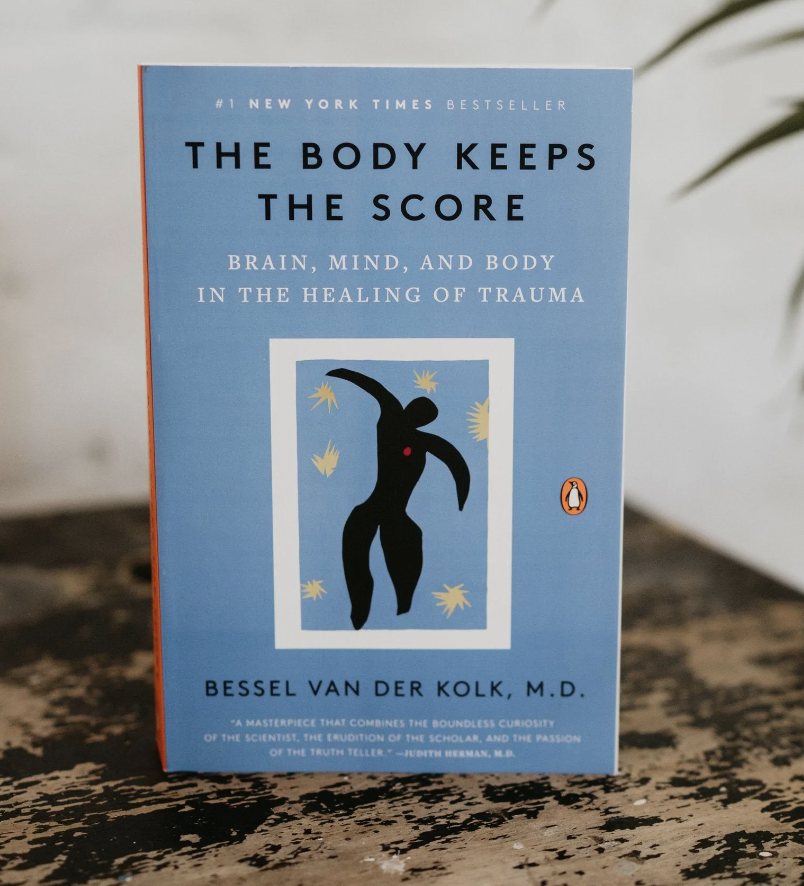
This quote about trauma and the body resonates with me. It is a reminder that we are more than our mind and our memories. We are embodied. Trauma moves us literally to the bone. To heal, we must heal our bodies and our minds.

“Trauma victims cannot recover until they become familiar with and befriend the sensations in their bodies. Being frightened means that you live in a body that is always on guard. Angry people live in angry bodies. The bodies of child-abuse victims are tense and defensive until they find a way to relax and feel safe. In order to change, people need to become aware of their sensations and the way that their bodies interact with the world around them. Physical self-awareness is the first step in releasing the tyranny of the past.

In my practice I begin the process by helping my patients to first notice and then describe the feelings in their bodies—not emotions such as anger or anxiety or fear but the physical sensations beneath the emotions: pressure, heat, muscular tension, tingling, caving in, feeling hollow, and so on. I also work on identifying the sensations associated with relaxation or pleasure. I help them become aware of their breath, their gestures and movements.

All too often, however, drugs such as Abilify, Zyprexa, and Seroquel, are prescribed instead of teaching people the skills to deal with such distressing physical reactions. Of course, medications only blunt sensations and do nothing to resolve them or transform them from toxic agents into allies.

The mind needs to be reeducated to feel physical sensations, and the body needs to be helped to tolerate and enjoy the comforts of touch. Individuals who lack emotional awareness are able, with practice, to connect their physical sensations to psychological events. Then they can slowly reconnect with themselves.”
― Bessel A. van der Kolk, The Body Keeps the Score: Brain, Mind, and Body in the Healing of Trauma

There’s 7 basic plots: overcoming the monster; rags to riches; the quest; voyage and return; comedy; tragedy;  rebirth. It’s profound to take any narrative in the world which exemplifies one of these plots and recast it as another, or to analyze a work of art from one of lens and then the other.

Is the Godfather “Overcoming the Monster” or “Rags to Riches” or “Quest” or “Voyage and Return.” Changing the lens with which you view the movie changes it meaningful.